Showing posts with label muziekinstrument - musical instrument. Show all posts

Tuesday, October 6, 2026

Washboard

The washboard (also known as a rub board) was originally a household tool for washing clothes by hand, but it has been played as a percussion instrument for over a century. 

Musical styles: The instrument is best known in zydeco, blues, jazz, skiffle, and bluegrass. 
Playing technique: The player usually wears the board across their chest (sometimes using straps) and strikes or scrapes the ribbed metal surfaces. 
This is often done using thimbles, spoons, sticks, or special metal brushes to produce a sharp, rhythmic, rasping sound. 

Variations: In modern zydeco music (from Louisiana), a more compact, all-metal "vest" version is often used; this is worn tight against the chest, allowing the player to tap and scrape it quickly and dynamically.


Saturday, July 4, 2026

Wagner Tuba

The Wagner tuba is a rare brass wind instrument, commissioned by Richard Wagner for his opera cycle *Der Ring des Nibelungen*. 

Characteristics: It is a hybrid between a French horn and a tuba: it looks like a horn (with rotary valves, played by horn players), but has a wider bore and an upward-facing bell like a tuba. 
There are two sizes: tenor (in B♭) and bass (in F). 
Sound: dark, warm, solemn, heroic, and mysterious – ideal for bridging the gap between horns and trombones. 
Wagner wanted a sound reminiscent of old Norse lures for the Valhalla motif. 
The instrument is usually used in quartets and appears in works by Wagner, Bruckner (including Symphony No. 7), Strauss, and others. 

In short: not a true tuba, but a special horn variant with a unique, rich sound.


Sunday, November 2, 2025

Xylophone

The xylophone is a percussion instrument with wooden bars of varying lengths, arranged in a chromatic scale. 
The bars are struck with mallets to produce bright, resonant notes. 
The name comes from the Greek "xylon" (wood) and "phōnē" (sound). 
It is often used in orchestras, marching bands, and modern music genres.


Friday, August 1, 2025

Xaphoon

The Xaphoon, also known as the "Pocket Sax," is a compact, chromatic single-reed wind instrument invented in 1972 by Brian Wittman in Hawaii. 
It has a cylindrical bore, a slightly flared bell, and uses a tenor saxophone reed. 
At approximately 30-34 cm in length, it produces a warm, rich sound similar to a clarinet or saxophone, suitable for genres such as jazz, klezmer, and world music. 
It has nine tone holes and a two-octave range. 
Originally made of bamboo, it is now also made of durable ABS plastic. 
The Xaphoon is portable, affordable, and accessible to both beginners and advanced players, but requires practice due to its unique fingering.


Saturday, May 10, 2025

Yoochin

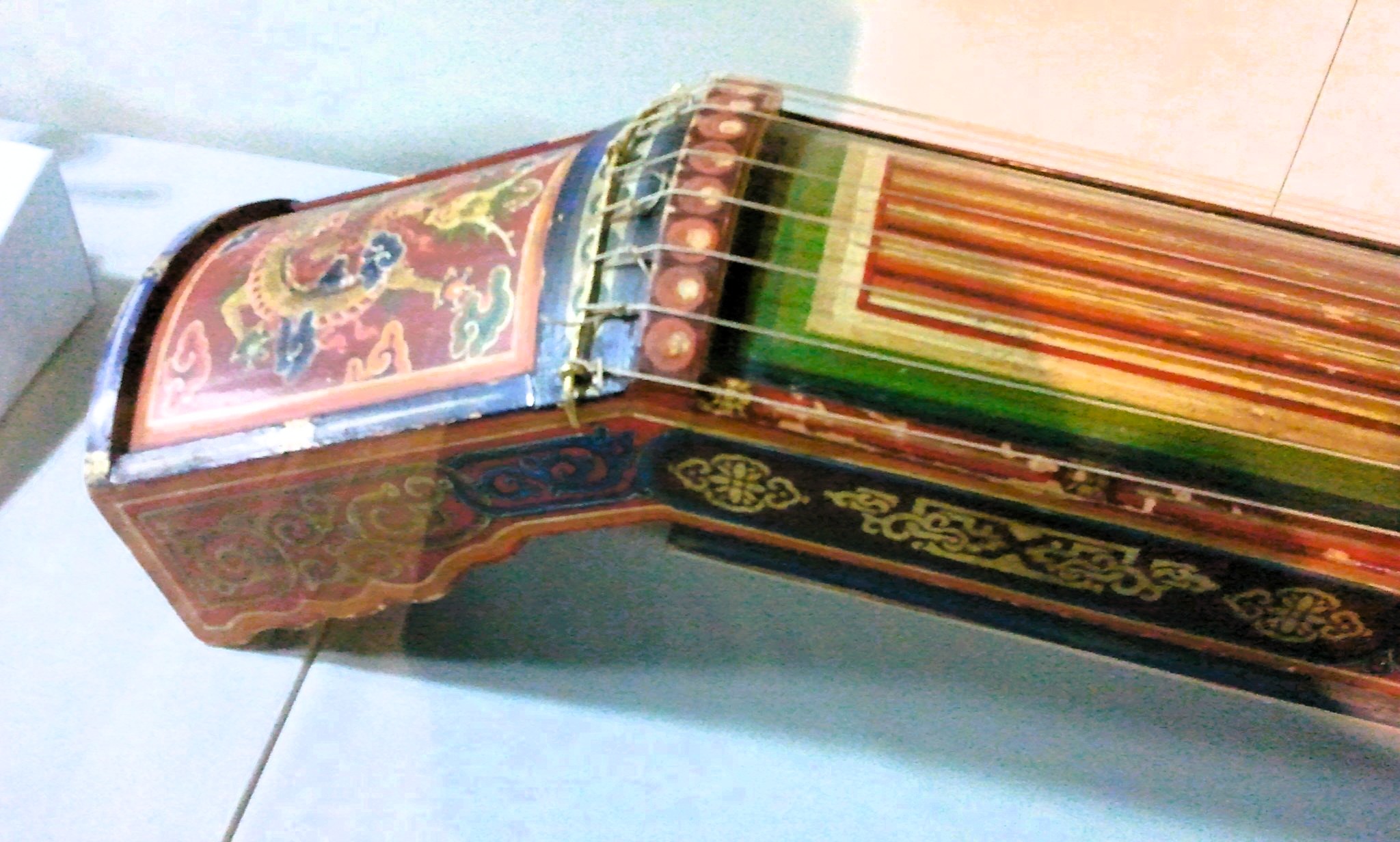
The yoochin is a traditional string instrument from Mongolia, belonging to the zither family. 
It has a long, flat sounding body with strings that are plucked or struck. 
The yoochin is often used in Mongolian folk music and has a characteristic bright, resonant sound. 
The instrument plays an important role in cultural and ceremonial music, where it is played both solo and in ensembles.


Sunday, January 5, 2025

Yatga

Yatga (pronounced yatak) is a musical instrument from Mongolia. 
It is a zither, which is related to the guzheng. 
The instrument has a mobile bridge for each string.


Tuesday, September 10, 2024

Zurna

The zurna is a double reed wind instrument played in central Eurasia, western Asia, and parts of North Africa. 
It is usually accompanied by a davul in Armenian, Anatolian, and Assyrian folk music.


Monday, April 15, 2024

Zummara

The zummara is also called zamr. 
It is a woodwind instrument consisting of two flutes tied together with a single reed. 
The two flutes can be played separately. 
The zummara is widely used in Turkish folk music.


Tuesday, December 19, 2023

Phonograph

The phonograph is the predecessor of the gramophone. 
The phonograph was patented by Thomas Alva Edison on February 19, 1878 and provided the first ability to record and play back sound.


Wednesday, September 6, 2023

Zobo

A zobo or songophone is a mirliton and therefore belongs to the membranophones, but most closely resembles a trombone. 
However, they have a diaphragm and are played like a kazoo.