Tuesday, November 15, 2016

Maloti-Drakensberg Park (South Africa)


The Maloti-Drakensberg Park is a transboundary site composed of the uKhahlamba Drakensberg National Park in South Africa and the Sehlathebe National Park in Lesotho. 
The site has exceptional natural beauty in its soaring basaltic buttresses, incisive dramatic cutbacks, and golden sandstone ramparts as well as visually spectacular sculptured arches, caves, cliffs, pillars and rock pools. 
The site's diversity of habitats protects a high level of endemic and globally important plants. 
The site harbors endangered species such as the Cape vulture (Gyps coprotheres) and the bearded vulture (Gypaetus barbatus). 
Lesotho’s Sehlabathebe National Park also harbors the Maloti minnow (Pseudobarbus quathlambae), a critically endangered fish species only found in this park. 
This spectacular natural site contains many caves and rock-shelters with the largest and most concentrated group of paintings in Africa south of the Sahara. 
They represent the spiritual life of the San people, who lived in this area over a period of 4,000 years.

The five most beautiful wallpapers and pictures of the Maloti-Drakensberg Park in South Africa.


Monday, November 14, 2016

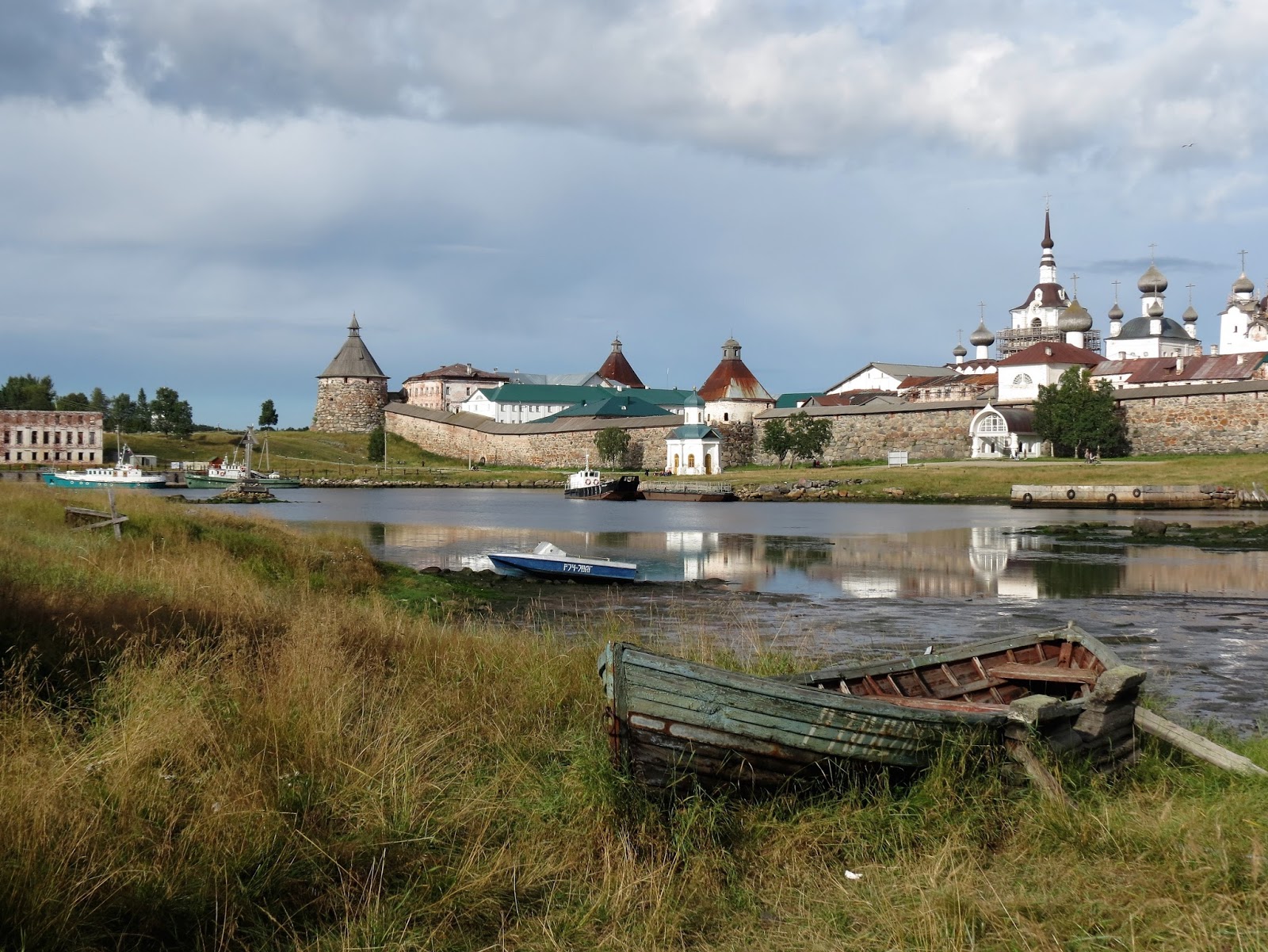
Cultural and Historic Ensemble of the Solovetsky Islands (Solovetsky - Russia)


The Solovetsky archipelago comprises six islands in the western part of the White Sea, covering 300 km2. 
They have been inhabited since the 5th century B.C. and important traces of a human presence from as far back as the 5th millennium B.C. can be found there. 
The archipelago has been the site of fervent monastic activity since the 15th century, and there are several churches dating from the 16th to the 19th century.

The five most beautiful wallpapers and pictures of the Solovetsky Islands in Russia.


Saturday, November 12, 2016

Dinosaur


Dinosaurs are a diverse group of animals of the clade Dinosauria that first appeared during the Triassic period. 
Although the exact origin and timing of the evolution of dinosaurs is the subject of active research, the current scientific consensus places their origin between 231 and 243 million years ago.

The five most beautiful wallpapers and pictures of the Dinosaur.


Friday, November 11, 2016

Monastery of Batalha (Batalha - Portugal)


The Monastery of the Dominicans of Batalha was built to commemorate the victory of the Portuguese over the Castilians at the battle of Aljubarrota in 1385. 
It was to be the Portuguese monarchy's main building project for the next two centuries. 
Here a highly original, national Gothic style evolved, profoundly influenced by Manueline art, as demonstrated by its masterpiece, the Royal Cloister.

The five most beautiful wallpapers and pictures of the Monastery of Batalha in Portugal.


Thursday, November 10, 2016

Historic Centre of Warsaw (Poland)


During the Warsaw Uprising in August 1944, more than 85% of Warsaw's historic centre was destroyed by Nazi troops. 
After the war, a five-year reconstruction campaign by its citizens resulted in today's meticulous restoration of the Old Town, with its churches, palaces and market-place. 
It is an outstanding example of a near-total reconstruction of a span of history covering the 13th to the 20th century.

The five most beautiful wallpapers and pictures of Warsaw in Poland.


Wednesday, November 9, 2016

Chavin (Archaeological Site) - (Chavin de Huantar - Peru)


The archaeological site of Chavin gave its name to the culture that developed between 1500 and 300 B.C. in this high valley of the Peruvian Andes. 
This former place of worship is one of the earliest and best-known pre-Columbian sites. 
Its appearance is striking, with the complex of terraces and squares, surrounded by structures of dressed stone, and the mainly zoomorphic ornamentation.

The five most beautiful wallpapers and pictures of Chavin in Peru.


Tuesday, November 8, 2016

Struve Geodetic Arc (Norway)


The Struve Arc is a chain of survey triangulations stretching from Hammerfest in Norway to the Black Sea, through 10 countries and over 2,820 km. 
These are points of a survey, carried out between 1816 and 1855 by the astronomer Friedrich Georg Wilhelm Struve, which represented the first accurate measuring of a long segment of a meridian. 
This helped to establish the exact size and shape of the planet and marked an important step in the development of earth sciences and topographic mapping. 
It is an extraordinary example of scientific collaboration among scientists from different countries, and of collaboration between monarchs for a scientific cause. 
The original arc consisted of 258 main triangles with 265 main station points. 
The listed site includes 34 of the original station points, with different markings, i.e. a drilled hole in rock, iron cross, cairns, or built obelisks.

The five most beautiful wallpapers and pictures of the arc of Struve in Norway.